Constellated Spatialities in Kowloon’s Shamshuipo & the New Territories’s Wang Toi Shan, Pat Heung
DR Tammy Kit Ping Wong
Site 1. Tai Nan Street, Shamshuipo, Kowloon
Tai Nan Street at the edge of the mixed urban district in Shamshuipo, presents a dense, dynamic, and territorially complex urban environment. It was my first step to a fresh perspective to explore the complex social and material production of space in Shamshuipo, and ground myself in the everyday of ethnic communities and traders to shape this territory into particular operations and practices.

Tai Nan Street – a section between Pei Ho Street and Nam Cheong Street, is filled with shops, hawker stalls, roadside minivans, and street vendors, all forming a part of the “second-hand” trade economy. One can find a variety of goods just like other streets in the market. But I feel myself as an outsider when walking along the street: I was surrounded by Pakistanis, some standing, others sitting by the roadside, or outside their shops, or beside their minivans on the roadside, engaging with their Hongkong, Indonesian and African customers. There was a sofa or then, not far, a Ludo board where traders relaxed with their cell phones, or played a round waiting for the police or government officers to walk by. There have been raids at times targeting illegal vending, as well as frequent police stops for identity papers and suspicions of drug dealing. Nevertheless, if one has seen through this, the authority has also looked the other way. This is yet one more open and accepted game, where yes there is authority, but there is the world of dense territorial operations in Shamshuipo.
Shamshuipo has long been described as a “poor” district, where low-income households live in the tiny subdivided flats (劏房 tongfong) in old tenement buildings (唐樓 tonglau), and Pakistanis have often posed as “marginalised” under the category of “ethnic minority”. Such descriptors primarily register on poverty, making Shamshuipo available to various interventions from Social Sciences, policy advocacy and NGO services. Nevertheless, this register would obscure how Shamshuipo has been continually made and remade. Even its subdivided flats evolving from postwar bedspaces, cocklofts, rooftops and then “caged homes”, to later cubicle rooms, “coffin rooms” and partitioned suites, are not just the evidences of deprivation, but sites of constant reconfiguration to resist a single logic of operation. Likewise, the market of Shamshuipo over decades has also thrived on the streets of dense social interweaving and constant improvisation within and beyond boundaries. Tai Nan Street thus shows a specific manifestation of heterogeneous urban life in this mixed urban area. These are sites of intense entanglements, where the life of the artifact, the repair, and refurbishment lie interspaced with their ethnic circulations across territories and relationships.
Tai Nan Street originally consisted of Hongkong small firms selling buttons and garment accessories. It formed a part of Shamshuipo’s traditional wholesale markets, once a centre for hundreds of shops and stalls trading fabrics and engaging in garment exports that proliferated during the post-war period. In the last decade, many shops have been run by Pakistanis in Tai Nan Street. Goods include clothing and accessories, tablewares, kitchen utensils, electronics, gadgets and appliances, jewellery and watches, cameras, phones and tablets, basically everything can be reused, sold and resold. This street economy may appear to be operated by the Pakistanis, but a closer look reveals its complex overlays of both artifacts and ethnicity. Terms like “second-hand” or “waste” may lose their meanings and mask the complexity and intensity of exchange; while the parked minivans themselves embody other layers of fluidity and porosity within and across the market. For decades, Pakistanis have been living and working in Shamshuipo, which has remained the centre for new arrivals to start and maintain their livelihoods. Housing has never been affordable in the city. One person recounted his life in Shamshuipo that a dozen men shared a single flat, including his father, uncles and people from the same hometown. Women and children joined later. Some moved in and out of Shamshuipo to other districts, but they return regularly. These market streets are where they navigate and organise their everyday lives: going to shops, restaurants, and mosques, meeting friends and sitting around to chat.
Shamshuipo has long functioned as the largest collection hub, consisting of different circuits of trades across time and space. Many have anchored their livelihoods in this market, thus gaining considerable knowledge of streets and shops: some worked for the owners of fabric shops, carrying large rolls of cloth throughout the market; others worked in second-hand electronics shops, collecting and transporting household appliances. Some engaged in small exchanges: looking for cheap things, like buying a device at HK$30 and reselling it for HK$50 elsewhere; or sitting on a stool at a street corner, negotiating with people to trade their old smartphones; or moving around different districts such as Tokwawan and Tsuen Wan, collecting discarded goods from households or shops. And now, they also handle larger quantities of trades – wrapping the machines with plastic film and loading them onto big lorries bound for warehouses or containers in Pat Heung. This dense, crowded and heterogeneous market facilitates practices of adjustment, collaboration, mutual watching, or just co-existence, where Pakistanis operate as street traders alongside their counterparts across ethnicities. The market functions as a constellation of open worlds within and beyond its immediate surroundings. We must describe places via their names, rather than their borders set in strict cartographic imprisonment. One needs to keep the market dynamic and moving, and swim on with and in it.
How then to think about, and situate the urban or as AbdouMaliq Simone would term, “the Cityness” of Shamshuipo? Here we have witnessed, even as I wander aimlessly, how the market has been subject to the multiple logics of practices and relationships that gave rise to very specific modalities of territorial operations. As a Hongonger, and know Kowloon so deep in my blood, yet, this walk reveals the complexity sensed over the years. This street operates along different rhythms that resists one form of domination and defies “a single large collective”. This is not the story of succession of “local” Chinese business to Pakistanis, as both groups have been working in Shamshuipo since decades. Nor is it a simplistic ethnic binary between Chinese or Pakistani, locals or migrants. Instead, I focus on how they participate in overlapping economic and social networks. These businesses are run differently by their own families, relatives, “brothers” from their Pakistan’s origins, but they can also be interrelated differently through various working relationships and connections. The minivans parked along two street sides set the trading rhythm, forming a part of a larger circuit of second-hand trades. They have long engaged in the market, once parking along the main hawker street outside the municipal market, in a “catch and hide” game or direct confrontations with authorities; some later moved into these second-hand shops in Tai Nan Street. Minivans continue to act like mobile traders without constantly moving around to avoid officers like before. They bring different goods to the street and create interweaving of different relations to the surroundings and reveal new extended urbans – boundaries that are not easily evident but temporally, slated in time, a rhythm of collecting items from public housing estates across the city. These minivans are the collectors, sellers, transporters and also suppliers to these second-hand shops and street traders, with long established contacts with garbage collectors in sites of exchange, communicating in fluent or simple Cantonese.
Mobile minivan traders also work individually. One of the traders I met collects electronics, clothes, and shoes, who would carefully avoid “trouble from others”. In contrast to his earlier efforts to “get along” with different people, he now prefers to work in his own way, free from others’ interference. He works long hours, often late into the night, driving to other areas to obtain goods even at the lowest price to secure his profit margin. But he also maintains relationships on the street. When he is away, he asks a friend to watch his van, giving him the car key in case any problem arises. He can secure a roadside parking space to sell goods, just like other minivan traders, given that these spaces are often informally “reserved” by nearby shops or people to place objects like bicycles to hold the spot. Every day, two or three officers arrive to suppress illegal vending. In response, street traders quickly signal one another to shut their van doors. It is not uncommon to see an officer gesture for a trader to close their door and end business for the moment. These officers now stay longer than before, patrolling around the street, while traders return to other routines: their Ludo game, sitting beside their vans, scrolling through their phones and chatting with each other. A conversation here, another there, open up their particularised stories often premised on “accidental” encounters. As I move to Wang Toi Shan (Site 2), a trader also connects up with the Pakistani community there. The point here is, can one really fix a definiteness to places such as Shamshuipo, and in a sense, to many others too? Do we need to go deep into specificities and complexities but not as “cases”, but as sites of layered connections, working the economy just as they work themselves within ethnic and across them to.
Second-(and Third-) Hands
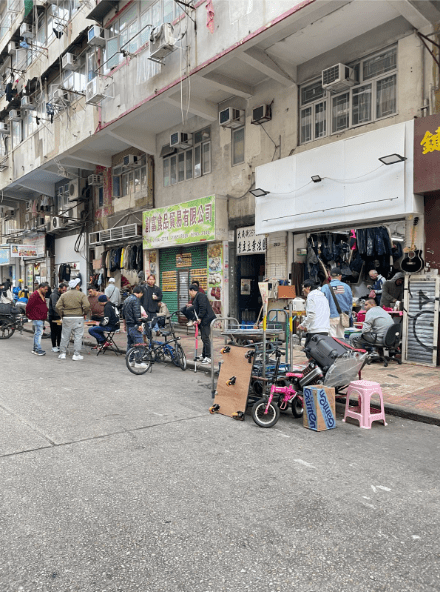
If hands as a body part are meant to sense things, our fingertips, our phone screens with magnetic displays, then can the sites of the second-hand also be ways of sensing the complex circulations of urban life? Consider these street stalls, shops and minivans: groceries, restaurants, second-hand domestic goods, electronics and appliances, and household gadgets. They spill out from the ground floors of the tenement buildings onto the roadsides. Run by Pakistanis on one side and Indonesians on the other, a few green-licensed hawker stalls (排檔 pai dang) are pushed slightly forward by owners, bringing them closer to the main rows of hawker stalls and drawing customers around the multi-storied municipal market. These stalls also extend their space outward, displaying an array of goods, with boxes and suitcases used to hold more items.
Both sides of the street are fully occupied by minivans, leaving just small space for people and cars to pass through especially during weekends. Their rear or side doors are left open, stocked with various goods, second-hand, and sometimes brand new. These rows of minivans form a kind of shield, behind which traders briefly spread their goods over large cloths or canvas on the ground. They must stay alert to the customers browsing their goods, the flow of people and the presence of authorities at the same time.
Scattered throughout Tin Nan Street are full of material things on the sidewalks, roadsides, alleys, shop fronts and street corners: bulging sacks of goods, trolleys, suitcases, a variety of chairs (stools, folding chairs or boss-styled office chairs), small tables, a large Ludo board game, and more. Even a single item such as a guitar was elegantly displayed on the roadside without a clear indication of who the seller was. A pushcart was piled with recycled electronics such as audio sets. Some bicycles were strategically placed in a specific parking space, effectively reserving it for a minivan trader. Some second-hand bicycles were placed at the street corner, where the trader and his friends sat on stools nearby. Another side of the street corner was the space occupied by a local Chinese man who piled and folded the carton boxes discarded from shops, and took them to nearby recycling shops for some income.
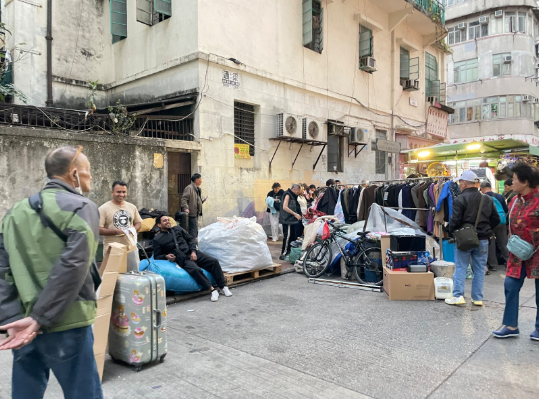
These second hand and discarded things are constellated into a broader set of social infrastructure: a gathering place, a living room, a play room, serving as sites of exchanges, performance and intersections that blur everything’s relations and boundaries – how people relate to one another, how things belong to and are arranged, and which rules are at play? They appear to synchronise with each other to perform this street economy.
At times, these practices collectively work together and effectively disturb the views of authorities and stricter rules. Pakistani men from other streets also gather here at particular times, while Indonesian women can be their customers and also collaborators. But a few Pakistani ladies who I talked to would not come to this street, except with their husbands. A minivan trader took me to a Pakistani grocery on the next street. We walked through the shop to the back, where he pressed a password to unlock a hidden restaurant. We had a very good breakfast there, and he talked about life in Shamshuipo. Another time, I became a “half” insider to get into these groceries’ hidden restaurants with a Pakistani truck driver. On the way he met his old friend, a Pakistani stall owner in another section of Tai Nan Street, and a visitor. The visitor was from Pakistan but seemed to be familiar with how trades work in Shamshuipo. This was midnight when the grocery was still open for hot food, and several other customers were eating in this hidden restaurant. We walked out to the dark street, where Tai Nan Street had been restored to clean, order and traffic function: no chairs left behind, and all the minivans were gone. The hawker stalls had been pushed back into the right place, all goods were packed inside, and locked behind metal doors, where a person was sitting on this green box in the dark to scroll his smart phone. Still many others were staying on other streets of Shamshuipo.
Constellated Spatialities
We need new words, in thinking of such a dynamic, transnational market as Shamshuipo, where Tai Nan Street hums with energy during the day, and various elements, people, practices and regulations are constellated into this everyday market and its urban differences (Simone, 2014). This became particularly important as traders increasingly feel anxious about business in the face of competition from Taobao online shopping, alongside multiple crises (political, economic and pandemic) in the city. They also confront the intensifying presence of authorities across the market: more officers, frequent patrols, and the everyday intimidation of police through document checks, body searches for drugs, or occasional arrests. Although such everyday practices take too much of their energy, they constitute collective forces in sustaining their livelihoods and social spaces, preventing them from fragmenting into individualised actions, and also shaping Shamshuipo’s multiplicities and pluralities at large.
While some claim that “Shamshuipo is the new Brooklyn”, others insist that “Shamshuipo is Shamshuipo”, defending its organic “grassroots” character against the reified local cultures that “gentrifiers” commodify and sell at high prices, as seen in new cafes and shops in the other section of Tai Nan Street. Nevertheless, we still lack the vocabularies and imagineries to grasp the heterogeneity and complexity of its everyday worlds. We need to further explore the specificities of its territorial operations and collective capacities that have emerged and navigated changes and contradictions over time, and that constitute what Simone terms the “urban majority” (Simone, 2013, 2014; Simone and Fauzan, 2012; Simone and Rao, 2012). Its improvisations and fluidity challenge the terms and descriptors that, when derived from the Kowloon walled city, or the Chungking Mansions, relegate it to a “ghetto”, a site of dystopic doom.
References
Simone, A. and Fauzan, A.U., 2012. Making security work for the majority: Reflections on two districts in Jakarta. City & Society, 24(2), pp.129-149
Simone, A. and Rao, V., 2012. Securing the majority: Living through uncertainty in Jakarta. International Journal of Urban and Regional Research, 36(2), pp.315-335.
Simone, A., 2013. Cities of uncertainty: Jakarta, the urban majority, and inventive political technologies. Theory, Culture & Society, 30(7-8), pp.243-263.
Simone, A., 2014. Jakarta, drawing the city near. University of Minnesota Press.
Simone, A. and Pieterse, E., 2018. New urban worlds: Inhabiting dissonant times. John Wiley & Sons.
Site 2. Wang Toi Shan, Pat Heung, the New Territories

Pat Heung is the ultimate site of operation, where traders from Shamshuipo collect second-hand electronics, transport them to warehouses there, and pack them into containers for shipment. This site relates to but also is very different from Shamshuipo. This is a vast area of urbanised villages in the New Territories. Pat Heung was once, and perhaps is still a far-away but spacious “countryside”. Located at the foot of Tai Mo Shan, the area lay some distance from Yuen Long old town centre, adjacent to Kamtin market, and the Tang lineage and their renowned walled village. The latter had been one of the “five clans” since pre-colonial Hong Kong. Pat Heung has been home to the Tang lineage (the oldest Punti lineage), and also several other surname villages, as well as many multi-ethnic residents since 2000.
For the first time, I took the West Rail from Shamshuipo (Nam Cheong Station) to Kam Sheung Road and got off a mini-bus at Wang Toi Shan, and people at this bus/mini-bus stop were from various ethnic backgrounds, especially Africans and Pakistanis. I joined a few community workers from a local NGO on their outreach activities, walking around the neighbourhood. These indigenous village houses are known as “ding houses”. They were built under the 1972 Small House Policy, as a political compromise between the colonial government and indigenous villages through Heung Yee Kuk, granting eligible male descendants of a lineage the right to construct a house. These are typically three-storied structures (about 700 square feet per floor), with what are now well-known “illegal” additional floors, enclosed balconies, and rooftop expansions.

Many village houses in this neighbourhood have been rented out to ethnic groups. We talked to three Pakistani families, who have settled in Wang Toi Shan for over a decade, and told us that they like the environment, which reminds them of their hometown in Pakistan. There are job opportunities for the husbands in the area. We arrived at a public park and a soccer field, which serves as a central gathering point for this multi-ethnic community in Wang Toi Shan. This park is a strategic site for this NGO’s community outreach to promote their services to different ethnic households. It was unbearable to stay in such an exposed area during the daytime of a hot summer. A community staff drove a car through a labyrinth of the industrial zone on the other side. It was rough and difficult to pass along with trucks from the opposite, and we finally reached a mosque.
We were in the surround of a large open field, consisting of many temporary metal structures used as warehouses, workshops and offices. This mosque and madrassa is located next to a scrapyard, which was fully occupied with motorcycles, used cars or stacked car bodies, washing machines, gyms equipment, and all kinds of second-hand electronics. This is a madrassa in the area, where children walk here daily after regular school to study. We greeted the person in charge with a brief introduction. Afterwards, we arrived at a nearby Pakistani restaurant, which is barely visible from the outside due to its temporary physical outlook. They serve dishes with hometown tastes so that the restaurant can attract Pakistani young people even from Shamshuipo. Finally, we returned to the park in the evening, and continued meeting with residents from Pakistan and one from the Philippines. People from different ethnic backgrounds began to come to this park, hang out with friends, while children played around the soccer field, where once Africans always played football.
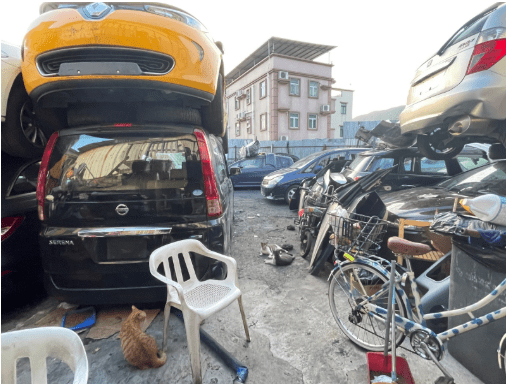
I also connected with a Hongkong lady C through my close social worker friend, who once engaged in a community network in Wang Toi Shan. I followed her to enter another new world of African community. She had also engaged in various “second-hand” trades in Pat Heung between 2000 and 2018. During this period, she collaborated with some African migrants and co-founded their African associations in this area.
We walked along a village road and entered a scrapyard run by Africans. We first turned and walked into a warehouse container. C introduced me to her African friend J from Nigeria, and we also greeted a newcomer K from Gambia. There was her kitchen. It was a long and narrow space, with an old small sofa, a small folding table and a chair, a fridge in the middle, next to boxes of beer, and a cooking space on the other side. The aircon was running but barely working. I looked suspicious to J, who called C (the Hongkong lady) “(African) mama” (to show her respect). C mentioned that it took years for them to become friends. I needed time to feel relaxed to be a stranger there: I paid her a bottle of beer, and she returned me some African dishes. We slowly started a casual conversation. We laughed because Africans were afraid of the cold in Hong Kong, while I was there just sweating unstoppably. She had once rented two warehouses from the owner of this scrapyard, one for cooking and another for seating. Now she can only maintain this kitchen to do takeaway. K has just arrived for a month with a tourist visit, and lived in Yuen Long with her sister. She earned HK$100 each day, by offering help in the kitchen. J noted that she “prepares meals for Africans”, given her status of an asylum seeker for a decade. Perhaps, she was not motivated to talk about her past, when I asked about her “adventure” to Hong Kong. Nevertheless her place serves as one of key sites for the African community in Wang Toi Shan. People came in and greeted her “(Nigerian) mama”. An African man sometimes came to J’s kitchen to take the box of beers. He always looked so playful, laughing and making jokes in front of us. He was married, and therefore holds an identity card. He is running a bar in a scrapyard rented from a Nigerian trader A, who is the first African to start business in Wang Toi Shan.
Outside, there were two other stacked warehouse containers, the lower was once for seating. Some used vehicles were some stacked one upon another. This scrapyard was smaller than A’s, who came to Wang Toi Shan to start his business in the late 1990s. His brother joined him and established a company next to his place. He had three daughters and I later met one of them, a mixed Nigerian-Hong Kong young lady. They collected used vehicles, machine parts and household electronics such as air-conditioners and refrigerators. He also helped Africans to get a visa to Hong Kong. C, the Hongkong lady, also collected everything households discarded, including items in very good conditions and even new. Her husband, also a Nigerian, collected tyres and engines. Their businesses also included sharing containers with other traders, who did not have their own warehouse, and stocked their goods and paid for the space of a container. In this way, as C said, she once earned more than USD$1000 for a container shipment. She rented a plot of land through a local property agent run by villagers. The land was large enough to accommodate their Nigerian trades, with one container also transformed into an African restaurant, another into a gathering site for the African Association. Manual labour has been available from African guys who know how to fully pack all goods into a container. As C said, “back then, one person packed a container during the busy season; but now several people share the job of loading goods into one container”.
That night, I met S, a Nigerian man who lives in the village with his son. Looking tired and quiet, he said, “I was just doing things to keep myself busy”. He seemed very different from how he appeared in a community-made video for the African association, where he had been an active member. In the video, he appeared cheerful and playful as he promoted African culture, demonstrating how to make semo (also known as “swallow” in Africa). However, circumstances subsequently changed, with stricter immigration policies, a difficult economic environment, and few job opportunities. Some of his peers had gone, or after they married local women to obtain citizenship. The African Association was financially unsustainable, particularly when C also closed her business in Wang Toi Shan. His wife returned to Indonesia. Nevertheless, he has made efforts to maintain his life as an asylum seeker for 15 years and to raise his son in Hong Kong.
The vast area of Pat Heung consisted of numerous “open storages”, an official term used by the Planning Department. The New Territories were undergoing a profound transformation after a 1982 court ruling allowed agricultural land to be used for non-agricultural purposes, provided no permanent structures were built (Merry, 2020; Nissim, 2021). This legal shift catalysed the proliferation of warehouses, container yards, scrapyards, and repair workshops across the countryside. Extended urbanisation accelerated in Yuen Long, with more private housing and condominiums being developed. Pat Heung also became integrated into the metropolitan area with the opening of Tai Lam Tunnel in 1998 and the West Rail line in 2003, however it developed in a different way. This vast agricultural region evolved into numerous open-air rental spaces for vehicles and large heavy machinery, established on both individual plots and ancestral communal landholdings (祖堂 t’so t’ong).
At the same time, new households began moving into the urbanised villages. Wang Toi Shan was thus transformed into multi-ethnic communities, including Pakistanis, Africans, Indonesians, Filipinos, Sri Lankans, Indians, Bangladeshis, and Nepalese (while Kam Tin has been home to a Nepali community whose history is linked to Gurkha soldiers stationed nearby Sek Kong barracks during the colonial past). These communities faced various forms of marginality and precariousness in Hong Kong. Many experienced everyday discrimination and rejection of their rights to live and work in the city. Some have been placed under surveillance as asylum seekers and suspended from employment. They found themselves trapped in endless asylum-seeking procedures. Nevertheless, they did not confine themselves to more established ethnic communities like Chungking Mansions, or limit their livelihoods in the markets of Sham Shui Po. Instead, these residents created an alternative form of urban life that extended across this wider village territory.
Over the past twenty years, people have been able to create new spaces and opportunities for themselves in Wang Toi Shan. This urban transformation, however, is not simply about “push and pull” factors that automatically move people around. Sometimes these efforts succeed, sometimes they fail, and sometimes they take unexpected directions. For example, Pakistani residents built a mosque in Wang Toi Shan, but failed to build one in another village site because local villagers opposed it. Or they could consider expanding the mosque in Yuen Long. Africans once organised cultural events with music, drumming, and food, and even formed a soccer team that played against the police team. Today, however, they struggle to keep their association running.
This extension of urban life requires different kinds of cooperation between people, bringing together scattered resources, histories, and practices in new ways (Simone, 2024). What kinds of social processes led to the concentration of today’s 60+ Pakistani companies in Pat Heung in transnational trade with China, Pakistan, Afghanistan, UAE, and Egypt? How was this transformed from the 1980s, when warehouse owners firstly recruited Pakistanis to work in this area as security guards to deter local triads and prevent extortions (protection money) (Ng, 2023)? How did Africans later step into this area and establish themselves, starting businesses and navigating Hong Kong-China-Africa trade networks? The area is not self-contained, but it connects to broader networks including Shamshuipo and Chungking Mansions. A trader in Chungking Mansions has his network in Wang Toi Shan, where he had worked for a few years, and has just obtained another business license for machinery and tools. Conflicts sometimes occur in everyday life. Landlords have always been present, monetising their land rights and exercising their authority over the area. There have also been various forms of threats and intimidation based on racial and cultural differences.
How do we understand all these transnational processes and social complexities? How do these urban extensions span across places and boundaries? During this research, I will further explore various relationships and opportunities emerging in this urbanised territory and the ways they reshape local dynamics and rhythms (Simone, 2024). We need new ways of understanding from the views of the residents, including different forms of agency, operations, and practices that have enabled life to flourish here and created possibilities for the future.
References
Merry, M., 2019. The unruly new territories: Small houses, ancestral estates, illegal structures, and other customary land practices of rural Hong Kong. Hong Kong University Press.
Ng, I., 2023. An unusual refuge: A case study of a South Asian and African multi-ethnic cluster in a Hong Kong rural walled village. Journal of Rural Studies, 98, pp.1-10.
Nissim, R., 2021. Land administration and practice in Hong Kong. Hong Kong University Press.
Simone, A., 2024. Urban life at the extensions. South Atlantic Quarterly, 123(2), pp.363-384
 Refurbishing Time
Leave a comment